Rumpelstiltskin’s bargain with Della’s father
One Thousand and One NightsRumpelstiltskin’s bargain with Della’s father turns a request for three wishes into a trap whose decisive price is not disclosed until after the promises are made: the jinn claims Della, his firstborn child. The father’s clever use of his wishes cannot undo the third commitment, and the bargain later threatens Della’s memory, inheritance, and freedom when she approaches her twenty-first birthday.
The Terms of the Bargain
The exchange begins with disagreement over what the father believes he is entitled to receive. He insists that the wishes are his, while Rumpelstiltskin counters that wishes must be matched by gifts. The father objects that he was not told this in advance and invokes a witch who should have explained the condition. Rumpelstiltskin answers not by relaxing it but by repeating the rule and mocking human inability to calculate. The disparity in information is already part of the bargain: the father is trying to exercise a benefit whose price he did not know.
When the father accepts the first gifts, he asks what the third item will be and pleads that it be anything but his soul. Rumpelstiltskin instead presses him to swear, first on his third toe and then by the hairs of his chin. The father agrees, believing he has sworn away everything but his soul and his meager clothing: the garment barely on his shoulders and the tattered shoes on his feet. Only after he has assured the jinn that his worldly possessions are available does Rumpelstiltskin beckon him closer to hear what the third gift will be. The withheld term makes the promise more than a contest over the value of objects; it exposes the risk of consenting before the obligation is known.
Wishes, Wealth, and the Hidden Price
The father’s later account distinguishes what he gained from what he failed to anticipate. His first wish gave him knowledge of how to obtain wealth rather than wealth itself. He also used his third wish to send Rumpelstiltskin back into the lamp, imprisoning him again. These uses show that the father could act cleverly within the wish arrangement. They do not cancel the prior promise: after the third wish, Rumpelstiltskin threw a tantrum and made clear that he still claimed the father’s firstborn child.
A memory of the father and Zaen entering a hidden treasure chamber connects the wealth to the wishes’ consequences. The father lights candles, approaches a pile of straw, and says the password “Open sesame.” A rug lifts to uncover stairs descending into a chamber filled with treasure. The scene presents the material reward alongside the bargain’s other legacy: the wealth can be found, but the promise concerning the firstborn remains unsettled. Rumpelstiltskin’s own association with turning straw into fairy gold further complicates the apparent gift. Later, Tante Iezavel’s sister Paribanou identifies the gold as something Rumpelstiltskin spun on the wheel his father gave him, and says humans cannot tell the difference. What the father received as fortune is thus bound to the jinn’s talent for exploiting mistaken judgments of value.
The Claim on Della
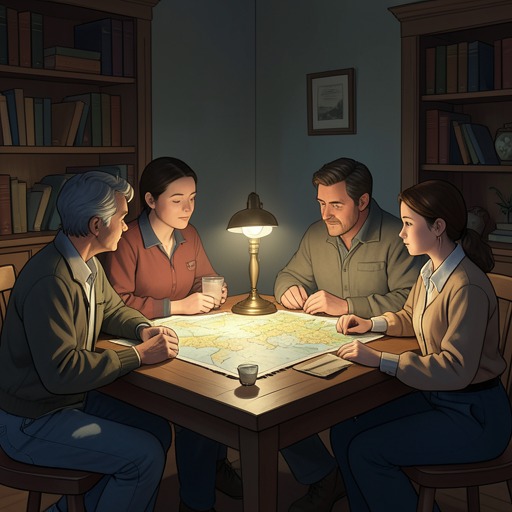
The bargain’s cost becomes a family crisis because Rumpelstiltskin treats the firstborn promise as a claim on Della. Her father explains that the jinn possesses her mother’s necklace and his own father’s ring as proof. When Della turns twenty-one, the father fears, she will be fully Rumpelstiltskin’s, and everything she is to inherit will pass to him. The threat is already taking effect before that deadline: the jinn’s hold is beginning to show, and Della may soon forget who she is. The original exchange therefore reaches beyond its maker. A promise made when the father was seeking wishes becomes a supernatural claim over his daughter’s identity and future property.
The father understands the bargain as a failure of judgment. He regrets agreeing to the third promise before learning what it entailed, repeating Rumpelstiltskin’s condition that there can be no takebacks or substitutions. His wife weeps as he wonders what the jinn wants with the treasure when he can make his own. The father suspects that inheritance explains the scheme, while his wife considers whether Rumpelstiltskin’s interest may be in Della herself. Neither possibility makes the bargain safer: the father has no power to revise the agreement, and its purpose remains uncertain to him.
Recognition and Resolution
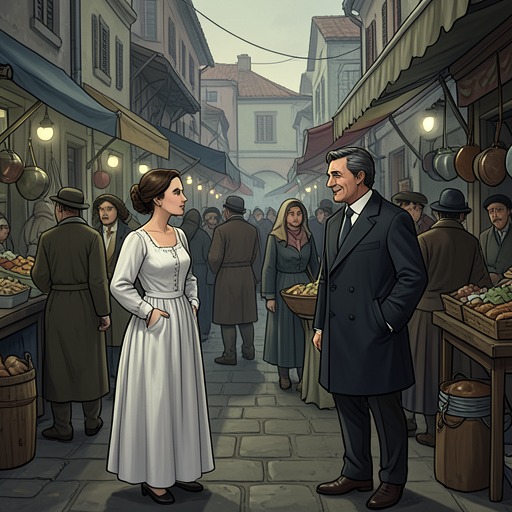
The story’s clues link the bargain to the familiar pattern of a jinn who spins straw into gold and demands that people guess his name. In the library, Tad finds a tale of a miller’s daughter tricked by a creature that spins straw into gold, although that version does not mention a lamp. Later, he and Claire encounter a merchant offering gold jewelry to anyone who can guess his name. The merchant’s challenge recalls the old tale, while Paribanou’s identification of Rumpelstiltskin and the spinning wheel connects the disguised figure to the family’s supernatural history.
The recovery of the lamp shows that capturing the jinn and lifting Della’s curse do not automatically settle every consequence of the bargain. Claire tells Zaen that Rumpelstiltskin has been captured and asks for the lamp, which Zaen is carrying concealed in his shirt. The demand marks a separate practical step after the claim has been disrupted: the object associated with the jinn must also be secured.
The bargain’s force is finally clarified by its contrast with Della and Zaen’s relationship. Zaen has proposed a thousand times, but Della distinguishes repeated romantic gestures from love and worries that he does not love her real self. He answers that he loves the person she is, including the girl who spoke to her horse and jumped hedges, and frames his thousand-and-first attempt as a bargain. Della accepts him without gold or jewels, asking instead that he be her dearest friend. Against the father’s uninformed promise, which binds Della to an unwanted claim, their engagement rests on her own answer and a mutual understanding of what is being offered. The plot thus sets coercive exchange against a freely chosen bond: the firstborn bargain makes a child the price of another person’s wish, while the ending gives Della a choice the bargain had threatened to take away.